A quick recap: Electricity is supplied in two forms, direct current (DC) and alternating current (AC). Some devices operate on DC, while others operate on AC. We have already had a brief introduction to DC motors. In this section, we introduce motors that operate on AC.
In our earlier article on DC motors, we introduced motors and discussed their basic operating principle. AC motors work on the same fundamental principle, but they operate differently because they use alternating current (AC) supply.
Types of AC Motors
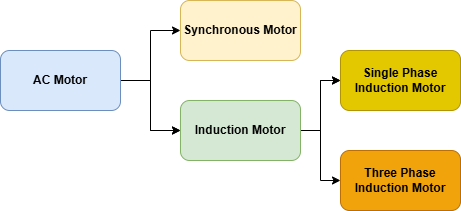
There are mainly two types of AC motors, based on their way of working:
- Synchronous motor
- Induction motor. It is also called Asynchronous motor. Based on the type of AC supply, there are single phase and three phase induction motors.
Parts of a Motor
Any motor will have two major parts. The stationary, unmoving part is called the Stator. The rotating part is called the Rotor.
Induction Motor - An Overview
Induction motors (IMs) are among the most widely used motors in industries and households. Their popularity comes from their strong, rugged, and robust construction. With fewer moving parts, these motors require minimal maintenance, making them highly reliable for long term use. As a result, induction motors are cost-effective both in terms of purchase and maintenance.
Let us have a brief overview of three phase IMs.
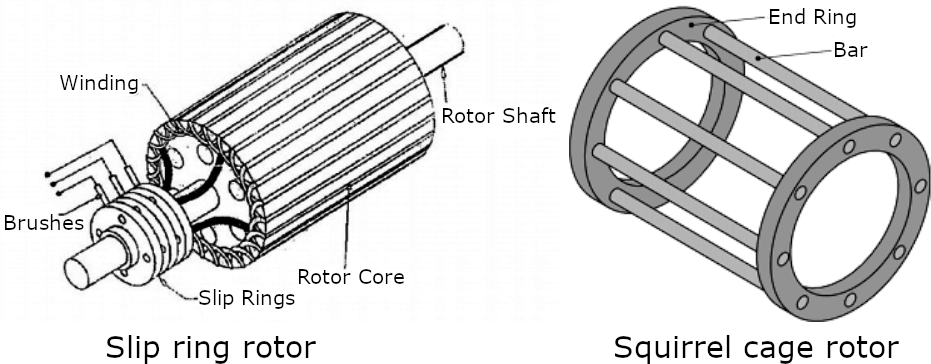
Based on construction of the rotor, three phase IMs are of two types: Squirrel cage and Slip ring (also called wound rotor).
Unlike a DC motor, an induction motor (IM) does not have physical magnetic poles. In other words, there is no visible or identifiable magnet inside an IM. Instead, the three-phase current generates a magnetic field that rotates in one direction. This rotating magnetic field causes the rotor to rotate in the same direction.
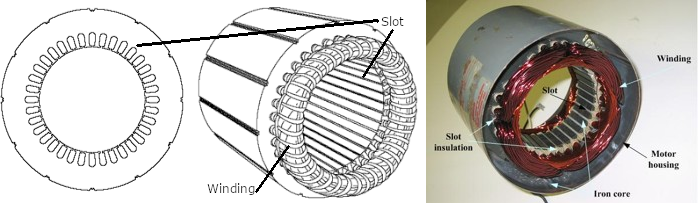
The stator contains slots that hold the stator windings, which carry electric current from the AC supply. The three-phase AC supply generates a magnetic field that rotates around the stator in one direction.
where –
* f is the frequency of the AC supply (in India, it is 50 Hertz)
* P is the number of poles.
As stated earlier, an induction motor does not have physical magnetic poles. The number of poles, P, depends on how the windings are arranged in the stator slots.
The rotating magnetic field induces current in the rotor winding, regardless of whether the rotor is a squirrel cage type or a slip ring type. The induced current then produces its own magnetic field. This rotor magnetic field interacts with the stator magnetic field, causing the rotor to rotate in the same direction as the stator field.
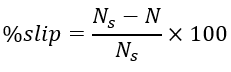
The rotational speed of the rotor does not match the speed of the rotating magnetic field in the stator. The rotor always rotates slightly slower than the stator field. This difference in speed is called slip. Engineers usually express slip as a percentage of the synchronous speed, Ns.
N – speed of rotation of the rotor
Is it good if there is no slip?
If the slip becomes zero, the rotor rotates at the same speed as the rotating magnetic field in the stator. In this condition, there is no relative motion between the stator field and the rotor conductors. Electromagnetic induction occurs only when relative motion exists between them. Without induced electromotive force (EMF), the rotor current becomes zero, and the rotor cannot produce its own magnetic field. As a result, the induction motor cannot develop torque, causing the rotor to slow down.
The rotor slowing down means the slip is introduced again, and the IM rotates normally.
Differences between Squirrel Cage and Slip Ring Rotors
Slip Ring Rotor
- Comparatively complex design
- Delicate due to more number of parts and windings
- Costlier than squirrel cage
- Less preferred than squirrel cage
- Has lower efficiency
- Advantage is that it can be connected to external circuit
- The external circuit can be used to vary speed
- Higher starting torque
- Used in cranes, hoists, conveyor belts
Squirrel Cage Rotor
- Very simple is design, just some bars and rings
- Robust and hardy
- Cheaper
- Most common type of rotor
- Has higher efficiency
- No external connections to rotor windings
- Difficult to control speed
- Lower starting torque
- Used in pumps, fans, lathes
Starting torque is the rotational force developed just before starting of the rotor, when the speed is zero.


Waiting for completing
Which is better, AC motor or DC motor?
Good