Quick summary of Reflection topic covered in CBSE and ICSE curriculum, across all the grades, in a simple manner.
Reflection is the change in the direction of a wave when it strikes the boundary between two different media and returns to the same medium. Common examples of reflection include the reflection of light waves and sound waves.
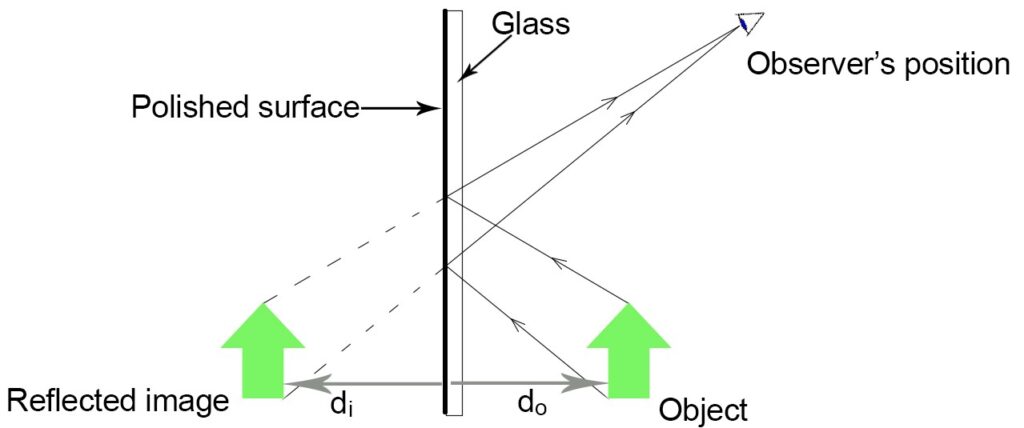
A plane mirror is a flat, smooth surface with one side coated with a shiny material. When light rays fall on the mirror, the smooth surface reflects them back, allowing us to see the image of the object in the mirror.
The apparent distance of the image, di is equal to the distance of the object, do, from the mirror.
Laws of Reflection
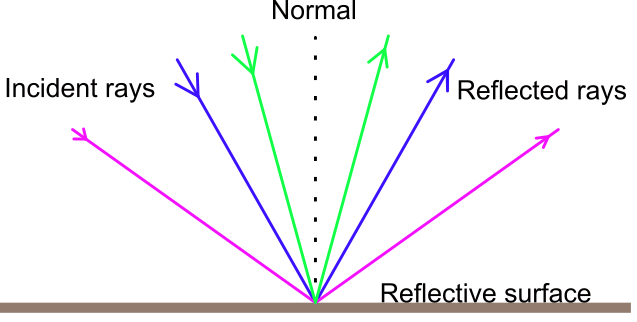
The angle of incidence is equal to the angle of reflection.
If the angle of incidence is 60o to the normal, the angle of reflection is also 60o to the normal
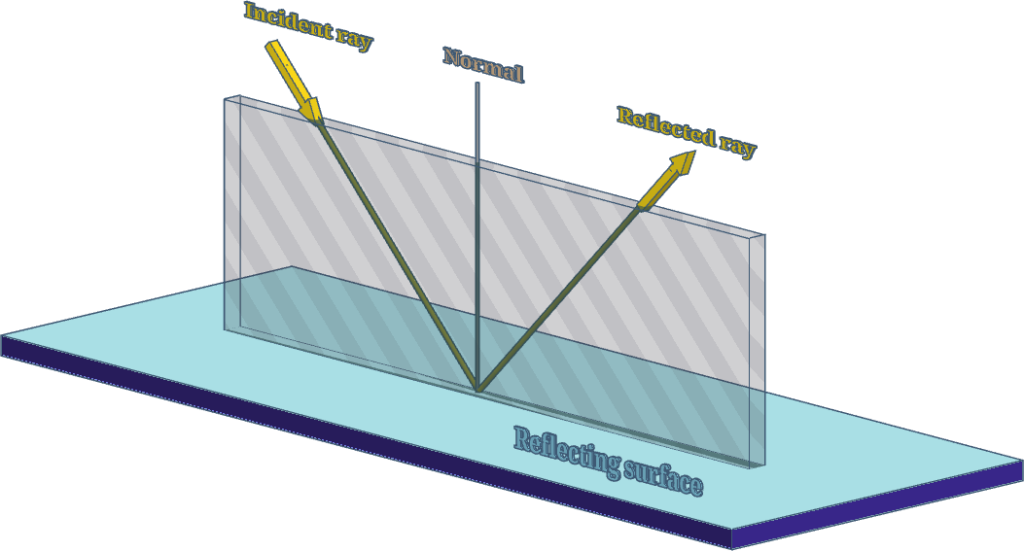
2. The incident ray, the reflected ray, and the normal to the surface at the point of incidence all lie in the same plane
Incident ray: It is the ray of light falling on the surface
Reflected ray: It is the ray of light bounced back from the surface
Normal: It is the line perpendicular to the surface at the point where the incident ray hits the surface
Angle of Incidence: The angle between the incident ray and the normal
Angle of Reflection: The angle between the reflected ray and the normal
Do laws of reflection apply only to plane surfaces?
No. The laws of reflection apply to all types of surfaces, including rough and curved surfaces. We can see objects around us because they reflect light into our eyes.
When parallel rays of light fall on a rough surface, the rays reflect in different directions. This scattering of light happens because the surface is uneven. At each point where light strikes the surface, the normal is different. As a result, the angle of incidence changes from one ray to another. Since the angle of reflection is equal to the angle of incidence, each reflected ray travels in a different direction.
This is called Diffused reflection.
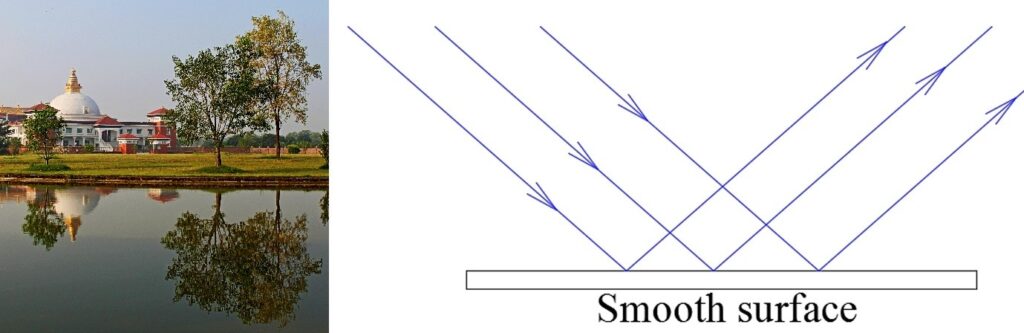
The reflection from a smooth plane surface such as a mirror or still water is called Regular reflection.
Terms related to images
Virtual Image: A virtual image is an image that can be seen but cannot be projected onto a screen. For example, the image formed by a plane mirror is a virtual image. Image in a plane mirror cannot be projected on to a screen.
Real Image: A real image is an image that can be projected onto a screen.
Upright Image or Erect Image: An upright or erect image has the same vertical orientation as the object.
Inverted Image: An inverted image appears upside down, with the top of the image opposite to the top of the object.
Enlarged Image: An enlarged image is larger in size than the object.
Diminished Image: A diminished image is smaller in size than the object.
Spherical Mirrors
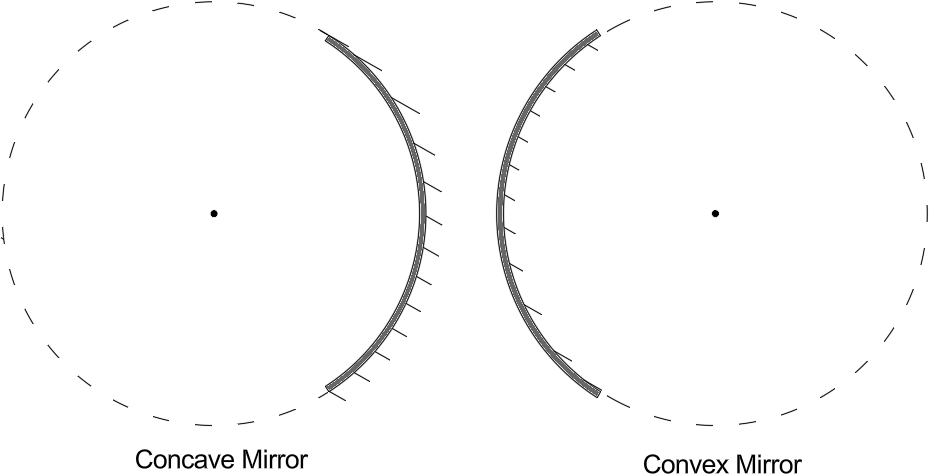
Two types of spherical mirrors are: Concave and Convex mirrors
Both are curved mirrors and are part of a sphere. In a convex mirror, the reflecting surface is the outer surface of the sphere. In a concave mirror, the reflecting surface is the inner surface of the sphere.
Terms related to curved mirrors
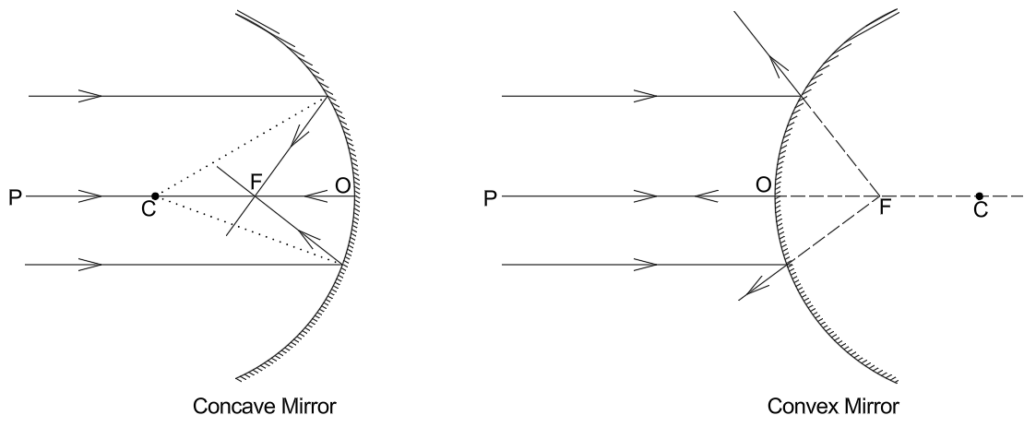
Centre of Curvature (C): The centre of curvature is the centre of the sphere of which the concave mirror or convex mirror forms a part.
Principal Focus or Focal Point (F): The principal focus is the point through which all reflected rays pass after reflection from a concave mirror. In a convex mirror, the reflected rays appear to diverge from this point when extended backward (shown by dashed lines). The principal focus lies in front of a concave mirror and behind a convex mirror.
Pole (O): The pole is the centre of the reflecting surface of the mirror.
Principal Axis (PO): The principal axis is the straight line passing through the centre of curvature (C) and the pole (O). It is perpendicular (normal) to the reflecting surface at the pole.
Focal Length (FO): The focal length is the distance between the pole (O) and the principal focus (F).
Radius of Curvature (CO): The radius of curvature is the radius of the sphere of which the mirror forms a part.
Aperture: The aperture is the diameter of the reflecting surface, assuming the surface is circular.
Normal at the Point of Incidence: In both concave and convex mirrors, the normal to the reflecting surface at the point of incidence passes through the centre of curvature (shown by dotted lines).
Convex Mirror
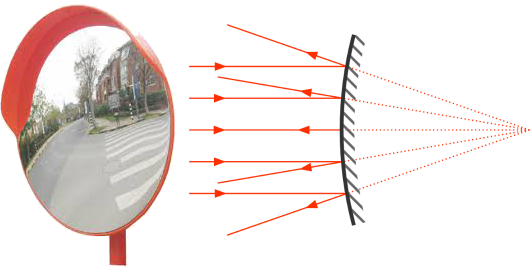
A convex mirror has its reflecting surface on the outer side of a spherical surface. Its surface bulges outward. Convex mirrors are commonly used near road bends, blind turns, and parking areas because they provide a wide view of the surroundings.
A convex mirror forms smaller (diminished) images of objects. Therefore, it allows us to see a larger area in the mirror, which helps improve safety on roads and in parking spaces.
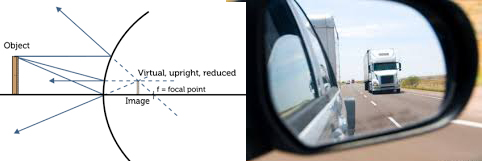
Rear-view mirrors in vehicles are convex mirrors. They provide a wide field of view, allowing drivers to see a larger area of the road and surrounding traffic. This feature helps improve road safety and reduces blind spots.
A ray diagram helps us determine the position, size, and nature of the image formed by a mirror. It shows how light rays reflect from the mirror to produce an image.
Concave Mirror
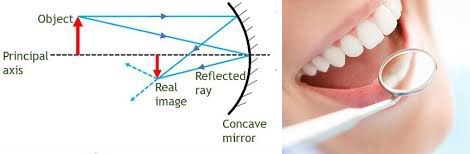
A concave mirror has its reflecting surface on the inner side of a spherical surface. Its surface curves inward, giving it a “caved-in” appearance. Concave mirrors are commonly used by dentists to examine teeth located deep inside the mouth. They are also used as shaving mirrors and in vehicle headlights.
The image formed by a concave mirror depends on the position of the object relative to the mirror. To determine the position, size, and nature of the image, we use ray diagrams.
Convex mirror
Reflecting surface on the outer part of the sphere.
Image formed is always upright and diminished.
Used on road bends, car parking, and as rear view mirrors in vehicles.
Concave mirror
Reflecting surface on the inner part of the sphere.
Image formed and its position depends on the position of the object with respect to the mirror.
Used by dentists, as shaving mirrors, in headlamps of vehicles.
In the next section, let us find the position and type of image formed by both concave and convex mirrors by drawing ray diagrams.



Pingback: Z
Good help