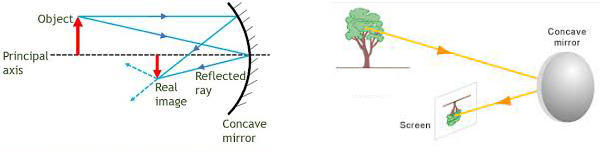
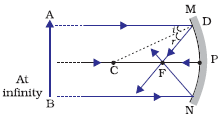
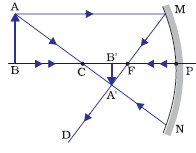
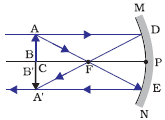
In this topic, we study how images are formed by concave and convex mirrors, by using ray diagrams.
From the earlier topic on Reflections, we know that there are two types of mirrors: Plane and Curved. Curved (or spherical) mirrors are of two types, Concave and Convex.
Ray diagrams and image formation in curved mirrors
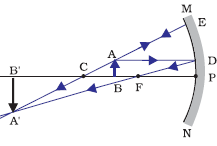
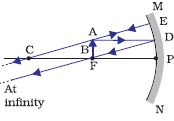
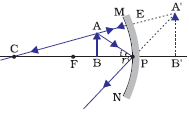
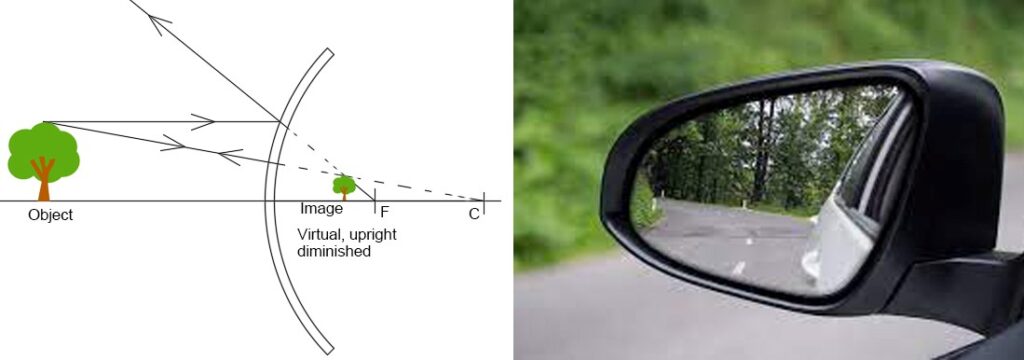
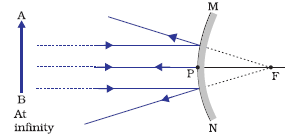
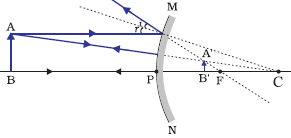
When an object is placed in front of a mirror, every point on the object reflects or emits light rays in different directions. For simplicity, ray diagrams usually consider only two rays originating from a point on the object, typically the top of the object. The point where at least two reflected rays intersect, or appear to intersect, gives the position of the image formed by the mirror.
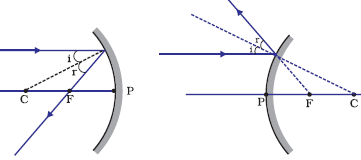
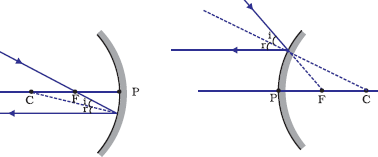
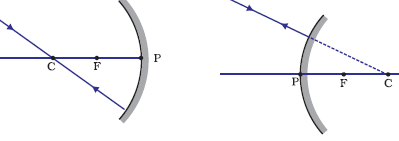
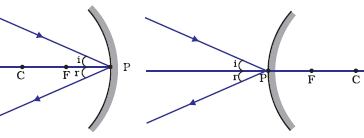
When drawing ray diagrams for concave and convex mirrors, we use the following rules:
Incident ray
Reflected ray
- Parallel to the principal axis
a. Passes through the focal point (F) in concave.
b. Appears to diverge out of F in convex.
2. Passing through the focal point (F) in concave, or directed towards it in convex
Parallel to the principal axis
3. Passing through the centre of curvature (C) in concave, or directed towards it in convex
Reflected back in the same direction as the incident ray
4. Incident on the pole (P) obliquely
Reflected with the same angle as that of incidence
Having set the rules for drawing ray diagrams, we can use them to form images in curved mirrors.
Image formation in a concave mirror
A concave mirror converges light rays onto a single point. The type of image formed depends on the position of the object it is reflecting.
- Real image: It can be focused on a screen and captured on a film or sensor. The object and the image will be on the same sides of the mirror. There is no lateral inversion of the image.
- Virtual image: We can only see this but cannot focus it on a screen. It will appear behind the mirror. The image is laterally inverted.