Resistor, Inductor, Capacitor - These are the three passive elements in an electrical circuit.
An electric circuit consists of active elements and passive elements.
An active element supplies energy to the circuit.
They control the flow of charges in a circuit.
Active elements need power to operate.
Examples of active elements are voltage source, current source, generator, transistor.
A passive element receives electrical energy.
They absorb, dissipate or store energy.
Passive elements do not need power to operate.
Examples are resistor, inductor, capacitor, diode, transformer.
Resistor
A resistor is a fundamental electrical component that limits the flow of electric current by offering a fixed resistance, based on its material properties. It has two terminals for circuit connection and efficiently converts electrical energy into heat, ensuring safe energy dissipation.
Resistance, measured in ohms (Ω), defines how much a resistor opposes electric current. In addition, according to Ohm’s Law, resistance is the ratio of the voltage (potential difference) across a component to the current flowing through it. Therefore, understanding resistance helps explain how resistors regulate current in electrical circuits
Inductor
An inductor is an electrical component that stores energy in the form of a magnetic field. Typically, it consists of a coil of wire and exhibits the property of inductance. Specifically, inductance refers to the ability of an element to generate an electromotive force (emf) in response to a change in current. It is defined as the ratio of induced emf to the rate of change of current. Therefore, inductance is represented by the symbol ‘L’ and is measured in henrys (H).
Capacitor
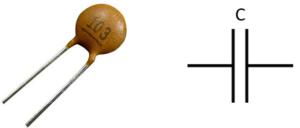
A capacitor is an electrical component that stores energy in the form of an electrostatic field. It consists of two conductive plates separated by an insulating material (dielectric). Additionally, the property of a capacitor that allows it to store electric charge is called capacitance, which plays a key role in filtering, timing, and energy storage applications.
Capacitance is a property of an electrical component that enables it to store charge in response to changes in voltage. Specifically, it is defined as the ratio of electric charge (or current, in AC circuits) to the rate of change of voltage across the component. Therefore, capacitance is represented by the letter ‘C’ and is measured in farads (F).
Frequently Asked Questions (FAQs)
Why is transistor considered an active element?
A transistor amplifies the input signal, increasing its power level. Because it controls power and can deliver energy to a circuit, it is classified as an active element.
Why is diode a passive element?
A diode does not change power levels. It does not need a voltage source to operate.
Why is transformer considered as a passive element when it varies voltage and current levels?
A transformer changes voltage and current levels while maintaining the same power on both the primary and secondary sides. Since it operates without requiring an external power source, it is considered a passive component.
This is the proper weblog for anybody who needs to find out about this topic. You understand a lot its virtually laborious to argue with you (not that I truly would want…HaHa). You positively put a brand new spin on a subject thats been written about for years. Great stuff, just great!




You should be a part of a contest for one of the greatest blogs online. I am going to recommend this site!
Came here while browsing. Great site and articles.
Well written
I like electrical articles. I believe you have studied electrical, from the way you write. Want more
I like this web site so much, saved to bookmarks. “Nostalgia isn’t what it used to be.” by Peter De Vries.
Pingback: Raghu Raj
Pingback: SS
Pingback: Sue
This is the proper weblog for anybody who needs to find out about this topic. You understand a lot its virtually laborious to argue with you (not that I truly would want…HaHa). You positively put a brand new spin on a subject thats been written about for years. Great stuff, just great!