We have seen how a current carrying conductor experiences a force when placed in a magnetic field. What happens if force is applied on a conductor inside a magnetic field? Let us see here.
In the article on electric motors, we explored how a current-carrying conductor moves when placed in a magnetic field, a phenomenon first observed by Andre Marie Ampère. Later, English physicist Michael Faraday discovered the reverse effect: a current is induced in a conductor when it moves through a magnetic field.
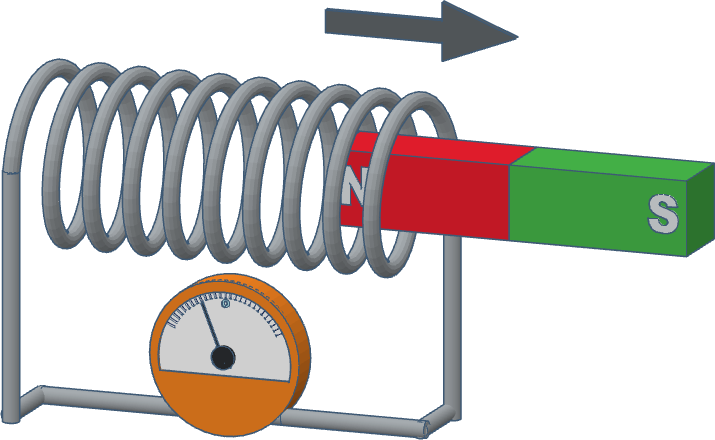
In Faraday’s experimental setup, a coil of wire is connected to a galvanometer. The galvanometer, one of the earliest instruments for detecting electric current in a circuit, indicates both the magnitude and direction of the current. It operates on the principle of the magnetic effect of electric current. With slight modifications, a galvanometer can be transformed into an ammeter to measure only current, or into a voltmeter to measure the potential difference between two points in a circuit.
When a bar magnet is moved into the coil of wire, the galvanometer needle deflects (rotates by an angle) in one direction. When the magnet is pulled out, the needle deflects in the opposite direction. Faraday observed this phenomenon and concluded that the motion of the magnet relative to the coil induces an electric current in the coil. This simple yet powerful experiment laid the foundation for the theory of electromagnetic induction.
The galvanometer needle also deflects when the magnet remains stationary but the coil is moved toward or away from it.
Electromagnetic Induction
When a magnet is moved near a coil of wire, or the coil is moved in a magnetic field, an electric current is produced in the wire. This phenomenon is called Electromagnetic Induction.
Mutual Induction
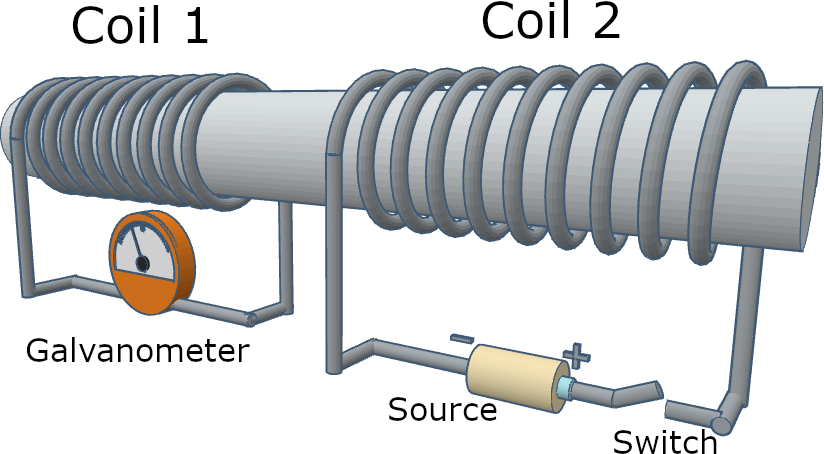
In the image above, two wire coils are wound around a hollow tube. Coil 1 is connected to a galvanometer, while Coil 2 is connected to a battery and a switch. When the switch is open, the galvanometer shows no deflection.
However, when the switch is closed, the galvanometer needle briefly deflects in one direction before returning to zero. When the switch is opened again, the needle deflects in the opposite direction, then settles back to zero.
This behavior indicates a momentary induced current in Coil 1 due to a changing magnetic field created by Coil 2. This phenomenon is called Mutual Induction. It is the basis on which devices called Transformers work.
What does a Transformer do?
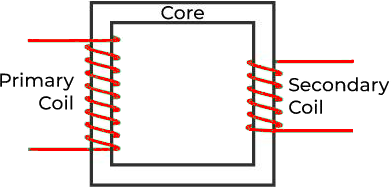
A transformer is a simple yet essential device used in AC (alternating current) circuits. Its primary function is to increase or decrease voltage levels as needed. It operates on the principle of mutual induction. In its basic form, a transformer consists of two coils wound around a common core.
The coil connected to the supply side is called the primary winding, while the coil connected to the load side is called the secondary winding. Both windings are wound on a common magnetic core.
There are no moving parts in a transformer. So its maintenance is very minimum.
When alternating current flows through the primary winding, it generates an alternating magnetic field in the core. This changing magnetic field induces an alternating current in the secondary winding, which is then delivered to the load. The number of turns in each winding determines the voltage induced in the secondary coil.
If the secondary winding has more turns than the primary, the secondary voltage becomes higher than the primary voltage. This type of transformer is called a step-up transformer, as it steps up or increases the voltage. Conversely, if the primary winding has more turns than the secondary, the output voltage decreases. This type is known as a step-down transformer, as it steps down or reduces the voltage.
Why is a transformer necessary?
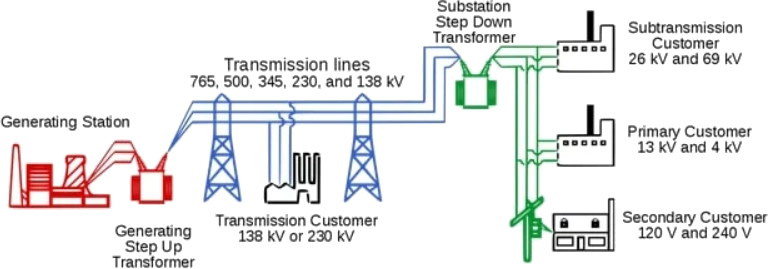
Electricity generated at a power station must be transmitted over hundreds of kilometers to the receiving end, known as the load. A typical generator produces electricity at 11 kV (11,000 volts). When electricity travels long distances, it experiences power losses and a drop in voltage. By the time it reaches the load, this voltage drop can become significant.
To prevent such losses, the voltage is increased to a very high level at the generator end before transmission. This is done using a step-up transformer installed near the power station.
At the receiving end, the voltage is gradually reduced through multiple step-down transformers until it reaches 440 V, which is suitable for domestic consumers.
You can certainly see your enthusiasm in the paintings you write. The arena hopes for even more passionate writers like you who are not afraid to say how they believe. At all times go after your heart. “No man should marry until he has studied anatomy and dissected at least one woman.” by Honore’ de Balzac.



You can certainly see your enthusiasm in the paintings you write. The arena hopes for even more passionate writers like you who are not afraid to say how they believe. At all times go after your heart. “No man should marry until he has studied anatomy and dissected at least one woman.” by Honore’ de Balzac.
Some more please
Fine write up
Worth a read