Electricity powers our everyday lives - from bulbs and fans to TVs, radios, and mobile phones. But has it always existed in human history? Not quite. The electrical devices we now rely on are the result of groundbreaking discoveries and inventions by scientists in the recent past.
In this article, we’ll explore the fascinating world of electricity - its origins, principles, and impact on modern life.
Electricity is a form of energy
Electricity is a fundamental form of energy that has existed since the beginning of the universe. Although humans began harnessing it only a few hundred years ago, the energy itself has always been present.
The electrical devices we use today, such as bulbs, fans, and mobile phones, are recent inventions that allow us to tap into this powerful force. In essence, electricity isn’t new, only our use of it is.
Electricity in nature
Lightning is one of the most common natural examples of electricity. Interestingly, certain animals can also produce electricity within their bodies. The electric eel, for instance, can generate up to 600 volts, powerful enough to stun its prey or escape predators.
Other animals that use electricity on a smaller scale include electric catfish, some species of sharks, as well as the echidna and the platypus. These creatures use electric signals for hunting, navigation, and self-defence.
Electricity in human bodies
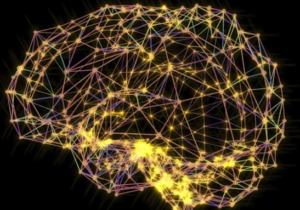
Humans, like all living beings, are part of nature, and electricity is an essential part of the human body. Our brains function through electrical activity, sending and receiving signals to and from every part of the body. In fact, the brain controls all bodily functions, including movement, reflexes, and even complex processes like thinking, feeling, and dreaming, using these electrical signals. The points where electrical signals pass between brain cells are called synapses.
Interestingly, researchers have found that the human body can generate enough electricity to power a mobile phone for up to 70 hours.
Our heart beats in a regular rhythm, but how does it do that? This steady beating is controlled by electrical signals generated within the heart. When the heart receives an electric impulse, its muscles contract suddenly, almost like experiencing a mild shock. This contraction pushes blood throughout the body, ensuring proper circulation. The process continues automatically and rhythmically from birth until death.
What is the source of electricity?
Now coming to the basic question, what is the source of all this? The answer is in atoms. We know that everything in the universe is made of atoms. Atoms are the tiny building blocks that make up everything – you, me, the chair we sit on, the water we drink, the air we breathe, and even the stars that twinkle in the night sky.
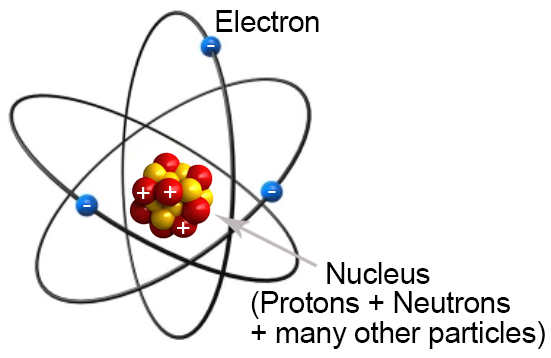
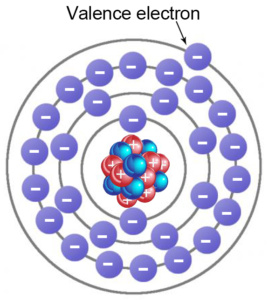
Atoms are primarily made up of electrons and a central nucleus. The nucleus contains two types of particles: protons and neutrons. Protons carry a positive charge, while electrons carry a negative charge. Neutrons, on the other hand, have no charge.
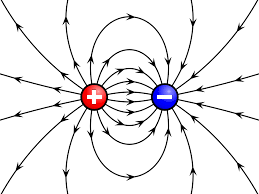
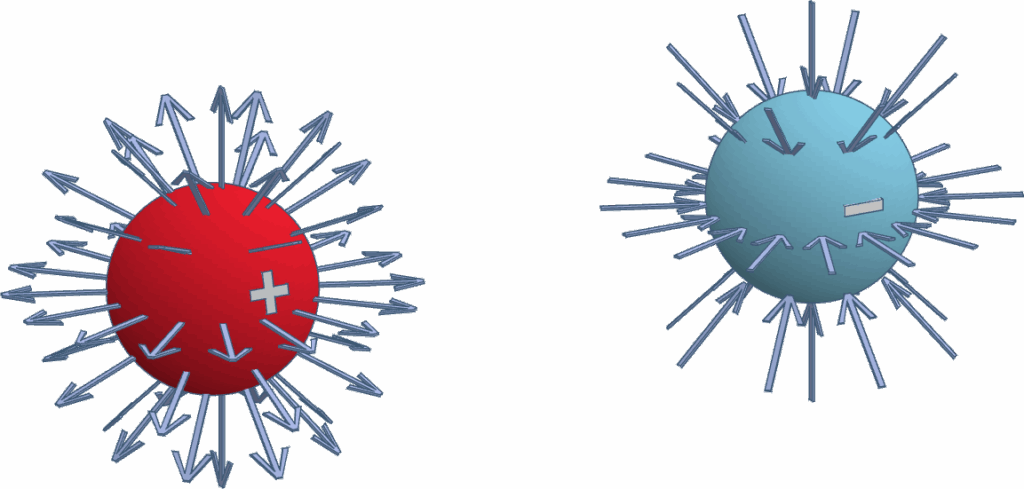
In physics, a charge refers to a property of matter that causes it to experience a force when placed in an electric or magnetic field. The area around a charged particle where this force is felt is known as a field. Field lines are imaginary lines that represent the direction and strength of this force. They show the path that a positive test charge would follow within the field.
If the field lines point outward from a particle, it indicates a positive charge. Conversely, if the field lines point inward toward the particle, it indicates a negative charge. A particle that does not experience any electric field is neutral, such as a neutron.
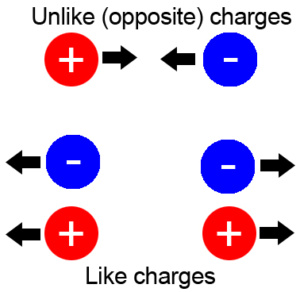
Unlike charges attract each other. A positive charge and a negative charge will naturally pull toward one another due to the force of attraction between opposite charges.
Like charges repel each other. This means that two particles with the same type of charge will push away from each other. For example, a positively charged particle will repel another positively charged particle. Similarly, negatively charged particles repel one another due to the repulsive force between them.
In an atom, the number of electrons is equal to the number of protons, making the atom electrically neutral. Electrons orbit the nucleus, and the outermost electrons are known as valence electrons. These valence electrons can be easily removed and are free to move within the material. When a material allows these free electrons to move from one end to another, it creates an electric current. This flow of electrons is what we refer to as electric current.
There is another type of electricity where charges remain stationary, it is known as static electricity.
Now that you have been introduced to the basics of electricity, we will explore more in upcoming articles, including its different types and key terms like current, voltage, resistance, and more.
Hi there very cool site!! Guy .. Beautiful .. Superb .. I will bookmark your blog and take the feeds additionally…I am glad to seek out numerous helpful information right here in the put up, we’d like develop extra strategies on this regard, thank you for sharing. . . . . .


Pingback: Sue
Pingback: Reddy
Pingback: Mohan Rao
Hi there very cool site!! Guy .. Beautiful .. Superb .. I will bookmark your blog and take the feeds additionally…I am glad to seek out numerous helpful information right here in the put up, we’d like develop extra strategies on this regard, thank you for sharing. . . . . .