When you enter a room from bright sunlight, it initially appears dark, but your eyes gradually adjust to the lower light. If you wake up at midnight to drink water, you can still move around easily, even without lights, because your eyes have adapted to the darkness.
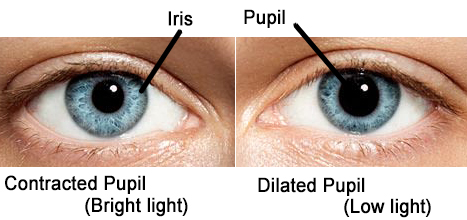
This experience happens because the iris controls the amount of light entering your eyes. The iris, a muscular diaphragm behind the cornea, adjusts its size based on the surrounding light. It expands or contracts, changing the size of the pupil—the hole in the center of the iris. In dim light, the iris contracts, making the pupil larger to let in more light. In bright light, the iris expands, reducing the pupil’s size to limit light entry.
A camera uses a diaphragm instead of an iris, while the aperture functions as its pupil. Simply put, the aperture is the hole that opens when the shutter clicks, allowing light to reach the film or sensor. It plays a crucial role in photography as one of the three pillars of the Exposure Triangle, along with ISO and Shutter Speed.
F-stop or F-number
Photographers measure aperture using f-stop or f-number. The f-stop scale includes values like f/1.4, f/2, f/2.8, f/4, f/5.6, f/8, f/11, f/16, and f/22. Some cameras display these numbers as f1.4, f2, f2.8, and so on. The lens and its focal length determine these values. Depending on the settings, intermediate values may also vary.
A smaller f-stop value means a larger aperture because the f-stop represents a ratio. The f-number is the ratio of the lens’s focal length to the aperture diameter.
Aperture diameter = focal length of lens/f-stop
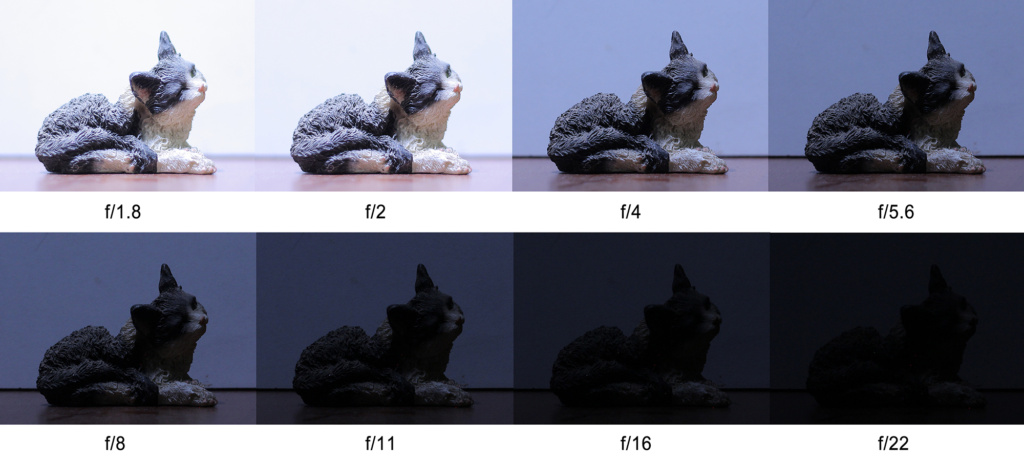
For each jump in f-number to its right, the aperture reduces by half. f/1.4 has the largest aperture while f/22 has the smallest aperture.
How does aperture affect the image?
Changing the aperture affects an image in two ways: It alters Brightness and Depth of Field (DOF).
Low f-stop -> Large aperture -> More bright, low DOF High f-stop -> Small aperture -> Less light, high DOF
Brightness
A lower f-stop increases the aperture diameter, allowing more light to enter. Increasing the f-stop number reduces the amount of light passing through the aperture.
Depth of Field (DOF)
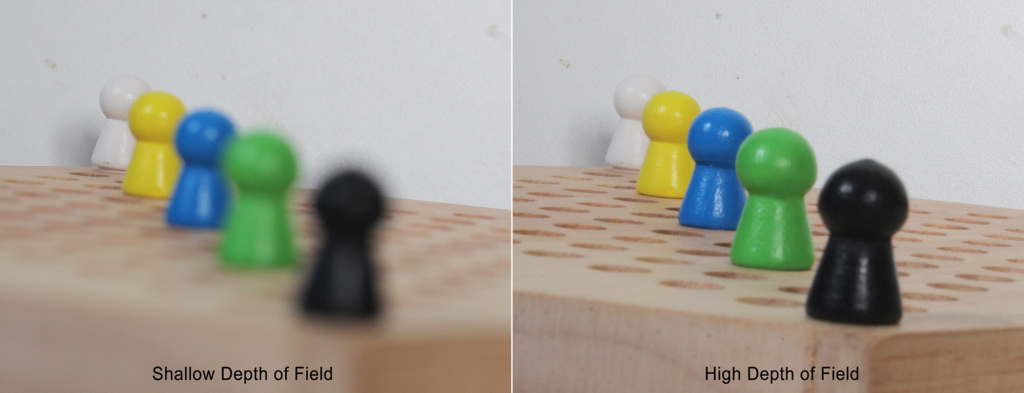
Depth of Field (DOF) determines how much of an image appears sharply focused. A shallow DOF keeps only a specific part of the image sharp while blurring the rest, commonly seen in portrait photography. A deep DOF ensures everything stays sharp and in focus, making it ideal for landscape photography.
In the first image above, the photographer sets the f-stop to the smallest value. The lens focuses on the white peg, making it sharp while blurring the other pegs. The photographer can adjust the focus to any object in the image, keeping it sharp while the rest remains blurred and out of focus.
In the second image, the photographer sets a high f-stop, ensuring everything appears sharp and in focus. A high f-stop is ideal for landscape photography, as it captures maximum detail.
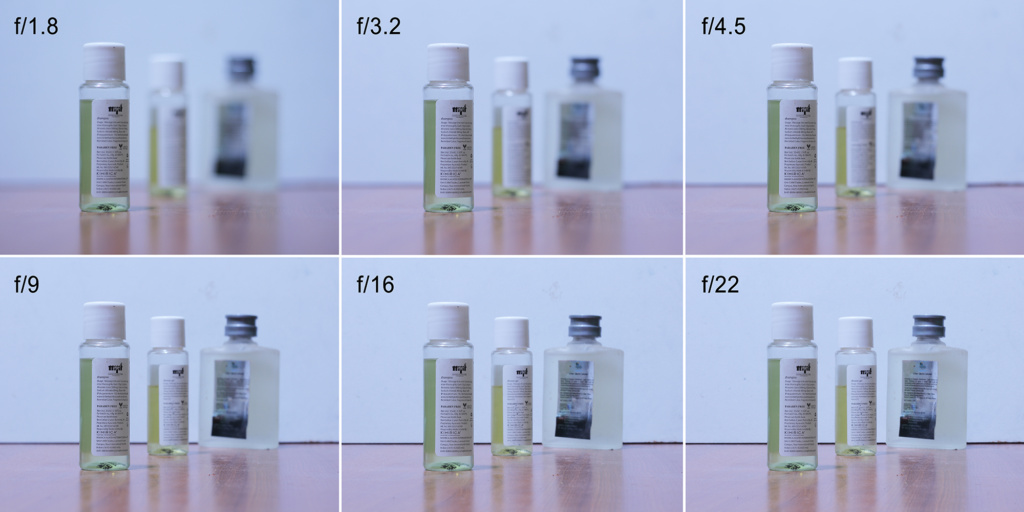
In this combo image, the photographer varies the f-stop from the lowest (f/1.8) to the highest (f/22) for a 50mm focal length lens. As the f-number increases, the sharpness expands, focusing first on a single bottle and eventually bringing all three bottles into focus.
The photographer maintains consistent brightness by adjusting the shutter speed while keeping the ISO fixed at 100 for all six images.
As a quick reference, use
a low f-stop for portraits and close-up shots. This setting keeps the subject in sharp focus while blurring the background.
a high f-stop for landscapes to keep the entire image sharp and clearly visible
Please let me know if you’re looking for a article author for your blog. You have some really great posts and I think I would be a good asset. If you ever want to take some of the load off, I’d really like to write some material for your blog in exchange for a link back to mine. Please blast me an e-mail if interested. Many thanks!
Thank you for goin through my blogs and writing to me. Will definitely get back to you later. If we collaborate, it will be great. Will decide and get back to you.
certainly like your website however you need to check the spelling on several of your posts. Several of them are rife with spelling issues and I to find it very troublesome to inform the truth then again I抣l certainly come back again.
I got this site from my buddy who shared with me about this website and now
this time I am visiting this web site and reading very informative articles at this time.
Hey I know this is off topic but I was wondering if
you knew of any widgets I could add to my blog that automatically tweet my newest twitter updates.
I’ve been looking for a plug-in like this for quite some time and was
hoping maybe you would have some experience with something like this.
Please let me know if you run into anything. I truly enjoy
reading your blog and I look forward to your new updates.
It’s a pity you don’t have a donate button! I’d certainly donate to this superb blog! I guess for now i’ll settle for bookmarking and adding your RSS feed to my Google account. I look forward to brand new updates and will share this blog with my Facebook group. Talk soon!
Thanks for another informative blog. Where else could I get that type of info written in such a perfect way? I have a project that I’m just now working on, and I have been on the look out for such information.
Hello! This is my first visit to your blog! We are a group of volunteers and starting a new project in a community in the same niche. Your blog provided us beneficial information to work on. You have done a marvellous job!
This is very attention-grabbing, You’re an excessively professional blogger. I’ve joined your feed and look ahead to searching for more of your wonderful post. Additionally, I’ve shared your website in my social networks!
I was curious if you ever considered changing the layout of your blog? Its very well written; I love what youve got to say. But maybe you could a little more in the way of content so people could connect with it better. Youve got an awful lot of text for only having 1 or 2 pictures. Maybe you could space it out better?
I have been exploring for a bit for any high-quality articles or blog posts on this sort of area . Exploring in Yahoo I at last stumbled upon this website. Reading this info So i’m happy to convey that I’ve an incredibly good uncanny feeling I discovered just what I needed. I most certainly will make sure to don’t forget this web site and give it a look on a constant basis.
I?¦ve read a few excellent stuff here. Certainly price bookmarking for revisiting. I wonder how much attempt you put to create such a fantastic informative web site.



Please let me know if you’re looking for a article author for your blog. You have some really great posts and I think I would be a good asset. If you ever want to take some of the load off, I’d really like to write some material for your blog in exchange for a link back to mine. Please blast me an e-mail if interested. Many thanks!
Thank you for goin through my blogs and writing to me. Will definitely get back to you later. If we collaborate, it will be great. Will decide and get back to you.
certainly like your website however you need to check the spelling on several of your posts. Several of them are rife with spelling issues and I to find it very troublesome to inform the truth then again I抣l certainly come back again.
Thank you for pointing out. Will check all pages and correct them.
I got this site from my buddy who shared with me about this website and now
this time I am visiting this web site and reading very informative articles at this time.
Hi to all, the contents present at this web page are genuinely remarkable for people experience,
well, keep up the nice work fellows.
Hey I know this is off topic but I was wondering if
you knew of any widgets I could add to my blog that automatically tweet my newest twitter updates.
I’ve been looking for a plug-in like this for quite some time and was
hoping maybe you would have some experience with something like this.
Please let me know if you run into anything. I truly enjoy
reading your blog and I look forward to your new updates.
I every time emailed this website post page to all
my contacts, for the reason that if like to read it after that my contacts will too.
I was looking at some of your posts on this internet site and I think this site is really informative! Continue posting.
Good writeup about aperture. Please write more articles about camera functions.
It’s a pity you don’t have a donate button! I’d certainly donate to this superb blog! I guess for now i’ll settle for bookmarking and adding your RSS feed to my Google account. I look forward to brand new updates and will share this blog with my Facebook group. Talk soon!
Thanks for another informative blog. Where else could I get that type of info written in such a perfect way? I have a project that I’m just now working on, and I have been on the look out for such information.
Hello! This is my first visit to your blog! We are a group of volunteers and starting a new project in a community in the same niche. Your blog provided us beneficial information to work on. You have done a marvellous job!
Good article about aperture. The comparison with eye is well written
This is very attention-grabbing, You’re an excessively professional blogger. I’ve joined your feed and look ahead to searching for more of your wonderful post. Additionally, I’ve shared your website in my social networks!
Did not know the comparison between camera aperture and eye. Simple to understand
Pingback: WN
Easy information about cameras
Easy to understand
Simple explanation about aperture
Cool
I was curious if you ever considered changing the layout of your blog? Its very well written; I love what youve got to say. But maybe you could a little more in the way of content so people could connect with it better. Youve got an awful lot of text for only having 1 or 2 pictures. Maybe you could space it out better?
I have been exploring for a bit for any high-quality articles or blog posts on this sort of area . Exploring in Yahoo I at last stumbled upon this website. Reading this info So i’m happy to convey that I’ve an incredibly good uncanny feeling I discovered just what I needed. I most certainly will make sure to don’t forget this web site and give it a look on a constant basis.
All essays very easy to understand. Write more.
Good
I?¦ve read a few excellent stuff here. Certainly price bookmarking for revisiting. I wonder how much attempt you put to create such a fantastic informative web site.
Good